Understanding Antique Carpets From the Evidence Up
The assumption that age alone determines a carpet's significance tends to dissolve the moment you begin examining one carefully. What follows is a structured walkthrough of the analytical framework this site applies to every piece it reviews — from the first physical observations through to the contextual conclusions and, equally importantly, the limitations that remain after all the evidence has been considered. You are invited to follow the reasoning at whatever pace suits you, and to question it wherever it seems to move too quickly past a complexity worth examining more closely.
Why the physical object must be the starting point for any serious review
Structural Assessment
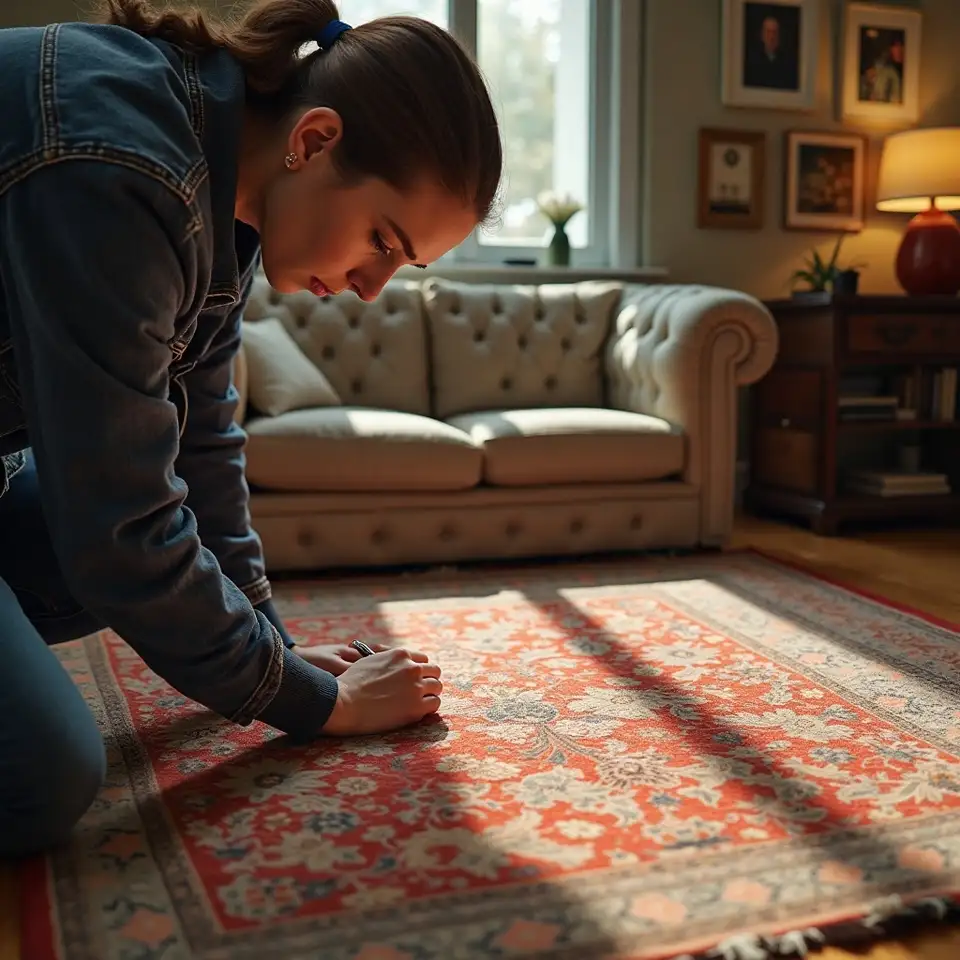
Before any question of origin, age, or historical significance can be meaningfully addressed, a carpet must be examined as a physical object. The foundation material — whether cotton, wool, or silk — establishes the basic parameters of the weaving environment in which the piece was produced. The knot type, whether symmetrical or asymmetrical, connects the piece to a broad family of regional traditions, though it does not by itself determine a specific origin. Knot density, measured in knots per square decimetre, offers a further constraint: finely knotted pieces require different tools, different workshop conditions, and different amounts of time than coarser work, and that difference carries historical implications. Pile height, pile direction, and the condition of the selvedges and kilim ends each add further detail to this initial structural picture. Areas of restoration are documented at this stage rather than later, because the boundary between original structure and later intervention is a fact about the object that should be established before any interpretive work begins. A carpet with significant restoration can still be historically important and analytically interesting — but the reader deserves to know where the original material ends and where subsequent repair begins, and that distinction must be established from direct physical observation rather than inferred from the piece's overall appearance.

Nuvsocdaecmaev
nuvsocdaecmaev.sbs
The Textile Record
Authentication and Historical Research — A Field Guide for Serious Collectors
How Natural Dyes Locate a Carpet in Time and Geography More Precisely Than Most Buyers Realise
Nuvsocdaecmaev
The dye palette of an antique hand-woven carpet is, in many respects, its most
precisely readable historical layer. Natural dyes are not uniform materials: madder
cultivated in the Anatolian plateau produces a chromatic signature that differs
measurably from madder grown in the Fergana Valley, and those differences persist in
aged textiles in ways that a trained eye — and, increasingly, spectroscopic analysis
— can detect and document. Indigo, the dominant source of blue across most major
weaving traditions before the late nineteenth century, carries its own regional and
period markers in the way it has been applied, layered, and combined with other dye
sources. Weld, pomegranate rind, and various tannin-rich mordanting materials each
contribute additional signals. Reading those signals systematically, against a
reference framework built from documented examples of known provenance, is the
second stage of the three-stage review process this site applies to every carpet it
examines. The introduction of synthetic dyes — aniline reds from approximately the
1860s onward, chrome dyes from the early twentieth century — provides a set of
dating constraints that are among the most reliable available to researchers. A
piece containing chrome yellow cannot predate the period of its commercial
availability in the relevant region, and that constraint, combined with structural
evidence, significantly narrows the range of plausible historical positions.
Differential fading, where some dyes have degraded more rapidly than others under
light and atmospheric exposure, can also reveal original colour relationships that
the current appearance of a carpet entirely obscures — making chromatic analysis
under varied lighting conditions a necessary step rather than an optional
refinement.
Contact us"A dye palette is not decoration. It is a dated, geographically specific document written in colour — and it can be read."
Regional Attribution: Moving From Broad Categories to Specific Historical Positions With Honesty About the Evidence
The process of attributing a hand-woven carpet to a specific region, period, and weaving tradition requires systematic cross-referencing of physical evidence against documented scholarship — and a clear account of where that process reaches its limits
Regional attribution is the stage of the review process most vulnerable to the pressures of market convention, where confident labels have historically substituted for careful argument. The methodology applied on this site treats attribution as a conclusion to be reached, not a starting assumption to be confirmed.
The structural and chromatic evidence gathered in the first two stages of the review process is cross-referenced against published scholarship on the relevant weaving traditions. This cross-referencing is not a simple pattern-matching exercise: it requires familiarity with the range of variation within a tradition, the ways in which neighbouring traditions have influenced one another, and the periods during which particular design elements were in common use. Where the evidence supports a precise attribution to a specific weaving group or workshop type, that attribution is stated with its supporting reasoning set out explicitly.
Where the evidence supports only a broader regional grouping — a general Anatolian attribution, for example, rather than a specific district or period — the review says so directly and explains which features prevented a more precise conclusion. This is not a failure of the methodology; it is the methodology working as intended. A clearly stated uncertainty is more useful to you than a falsely precise attribution, because it tells you where your own further enquiry should be directed and what additional evidence might resolve the question.
Contested attributions — pieces whose origin has been argued differently by different scholars — are handled by presenting the competing positions and the evidence each draws upon, rather than by selecting one view and presenting it as settled. The antique textile field has a substantial history of attributions that were revised as scholarship advanced, and the reviews on this site are written with that history in mind. A position stated as contested today may be resolved by future research; a position stated as certain today may be revised by the same process.
The contextual stage of the review also draws on whatever documentary record surrounds
the piece — auction catalogues, exhibition records, estate inventories, scholarly
citations, and dealer correspondence where it has survived. This documentation is
treated as corroborating or complicating evidence rather than as authoritative source
material, because the commercial and curatorial pressures under which such documents
were produced do not always align with the standards of historical accuracy that a
research review requires. The relationship between the documentary and the physical
evidence is always stated explicitly.
Limitations, Uncertainty, and What Honest Textile Research Acknowledges That Market Commentary Typically Does Not
Every analytical review on this site concludes with an explicit account of what the analysis was unable to determine — because legible uncertainty is more useful to a careful reader than the appearance of completeness
The most important section of any serious analytical review is not the attribution
conclusion. It is the limitations statement — the part that tells you precisely what the
analysis could not establish, and why.
Authentication in the antique textile field involves irreducible uncertainty. No
methodology, however carefully applied, can produce absolute certainty about a piece
whose maker left no written record, whose early history is undocumented, and whose
physical condition has been shaped by a century or more of use, storage, cleaning, and
handling. The three-stage process described on this site is designed to produce a
well-reasoned, transparently argued analytical position — not a verdict. The difference
between those two things matters enormously for how you should use the conclusions.
02
Common sources of limitation include restricted physical access — where a review has
been conducted from high-resolution photography rather than direct examination, or where
the back of the carpet was not available for inspection. They also include gaps in the
documentary record, ambiguity in the physical evidence that falls between two plausible
attributions, and the current state of scholarship on a particular weaving tradition,
which may not yet have resolved questions that the physical evidence raises but cannot
answer on its own.
The antique textile market is also subject to fluctuations in scholarly consensus that can affect how a piece is understood and valued over time. An attribution that was widely accepted a generation ago may have been refined or contested by subsequent research, and the reviews on this site are updated where new evidence materially affects the analytical position. Readers are encouraged to treat every review as a dated document — a record of the best analytical position achievable from the available evidence at the time of writing — rather than as a permanent and final account.
04
Nothing on this site constitutes financial, legal, or investment advice. The analytical
framework described here is a tool for understanding antique textiles more precisely —
it is not a framework for predicting market behaviour or for making acquisition
decisions without independent professional guidance. Past performance in any asset
category, including antique hand-woven carpets, does not predict future outcomes, and
every piece of market-adjacent commentary on this site is written with that boundary
clearly in view. Readers in Canada and elsewhere are encouraged to seek qualified
independent advice before making any consequential decision in this field.
Condition, Restoration, and What the Physical Record of a Carpet's Life Actually Tells You
A carpet's condition is often treated in market contexts as a straightforward quality metric — better condition equals higher desirability, and significant restoration equals a discount to be negotiated. That framing is not wrong as far as it goes, but it leaves most of the interesting information on the table. The physical record of how a carpet has aged, been used, been stored, and been repaired is also a historical document, and reading it carefully adds a dimension to the analytical picture that a simple condition grade entirely omits. Wear patterns, for instance, are not merely signs of use: they record the specific way in which a carpet was deployed. Even fading across a central field suggests extended exposure to light from a consistent direction. Localised wear at one end may record a threshold position. Systematic creasing along parallel lines records long-term storage folded rather than rolled — a detail that can corroborate or complicate other aspects of the provenance account. Restoration history is similarly informative. The materials and techniques used in repairs carry their own period and regional markers, and a restoration that can be dated to a specific era adds a layer of documentary evidence about the piece's history of ownership and care. Where restoration has been carried out using synthetic dyes introduced after the carpet's probable date of production, that anachronism is noted explicitly — not as a condemnation of the piece, but as a fact about its physical record that the reader needs in order to assess the analytical conclusions accurately. The goal of condition assessment, as practised on this site, is to describe the physical record of the carpet's existence as completely and honestly as the available evidence allows. That description is then integrated with the structural, chromatic, and contextual analysis to produce a composite picture that is more historically legible than any single dimension of the review could provide on its own.


Explore Further
Questions about a specific piece, a weaving tradition, or how the three-stage review process applies to a particular case
The information on this page is intended as a starting point — a map of the analytical
territory rather than a complete account of every path through it. Different pieces
raise different questions, and the review process adapts to the evidence each object
presents rather than applying a rigid template regardless of what the physical
examination reveals. If you have a specific question about a weaving tradition, a dye
analysis result, or the limits of what authentication can reasonably establish in a
particular case, the research team welcomes considered enquiries. Clear, specific
questions tend to receive the most useful responses, and the team reads every message
before deciding how to direct it appropriately within the group.
Contact us
Six Things Worth Understanding Before Approaching This Field Seriously
The antique textile market rewards careful preparation more reliably than it rewards confident intuition. These are the analytical reference points that researchers and collectors with sustained engagement in the field tend to identify as the most practically useful — not as rules, but as orientations that change the quality of the questions you ask and, consequently, the quality of the answers you receive from the evidence in front of you.
Attribution is an argument, not a fact
Every regional attribution rests on a chain of reasoning from physical and documentary evidence. That chain can be stronger or weaker, more or less explicit, but it is always a reasoned position rather than an objective discovery. Evaluating an attribution means evaluating the reasoning, not simply accepting or rejecting the conclusion on the basis of the confidence with which it is stated.
Dye chemistry is among the most reliable dating evidence
The introduction of synthetic dyes into specific weaving regions at documented periods provides dating constraints that are more reliable than stylistic analysis alone. A piece containing chrome dyes cannot predate their commercial availability in the relevant region, and that constraint is independent of the reviewer's aesthetic judgements about the piece or the period.
Condition affects legibility, not only value
A carpet in heavily worn or significantly restored condition is harder to read analytically — not simply less desirable commercially. When key areas of the pile are gone, the dye evidence and the weave structure in those areas are also gone, and the analytical conclusions must be stated with correspondingly greater uncertainty. Condition assessment and analytical assessment are not separate exercises.
Provenance documentation is corroborating evidence, not proof
Auction records, estate inventories, and dealer certificates establish a chain of
appearances rather than a chain of verified facts. They are useful corroborating
evidence when they align with the physical analysis, and they are important
anomalies to investigate when they do not. Treating documentation as authoritative
without cross-referencing it against the object itself is a common source of
misattribution in this field.
Scholarship in this field continues to evolve
Attributions that were standard in the literature a generation ago have been
revised, refined, or contested as access to primary materials has improved and
methodologies have advanced. Staying oriented to the current state of scholarship —
rather than relying on older reference works as though they represent settled
knowledge — is a discipline that distinguishes productive research from the
repetition of inherited assumptions.
No analytical review substitutes for independent advice
The research and analytical commentary published on this site is a tool for
understanding antique textiles more precisely. It is not a substitute for
independent financial, legal, or specialist advice for anyone considering antique
carpets in the context of a broader asset or collection decision. Past performance
in this or any asset category does not predict future outcomes, and results in this
field vary significantly from case to case.